
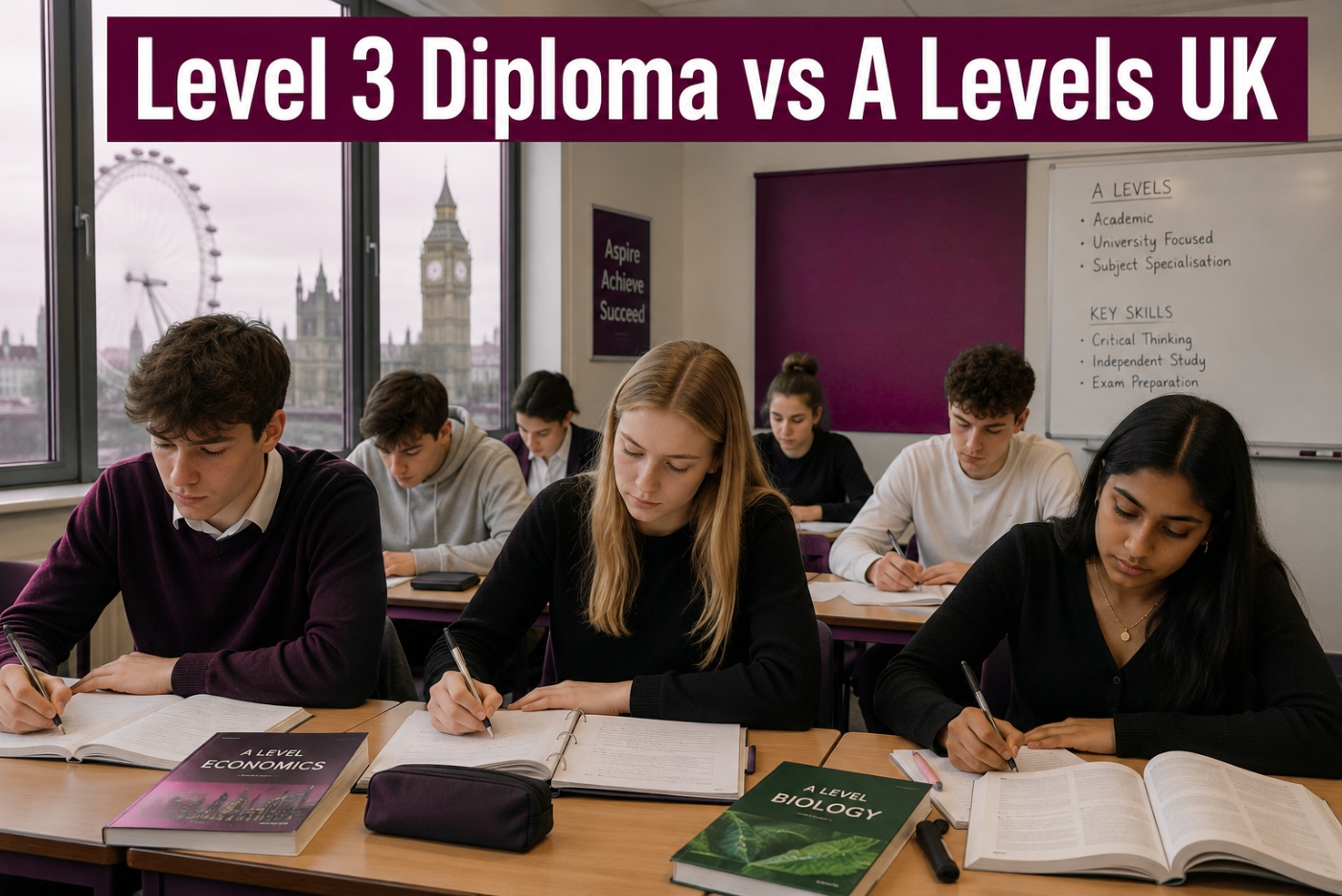
The Level 3 Diploma vs A levels UK debate comes up for almost every student making a qualification decision in Year 11 or returning to education as an adult. Both qualifications sit at Level 3 on the UK framework. Both carry UCAS tariff points. Both are accepted by UK universities for undergraduate entry. Beyond those three facts, almost everything else differs, and for students targeting business management, marketing or executive education careers, the differences matter a great deal. This is the comparison no one gives you in a school prospectus.
Level 3 Diploma Vs A Levels UK: The Structural Difference
The Level 3 Diploma vs A levels UK comparison begins with how each qualification is assessed. A Levels are assessed almost entirely through written examinations sat at the end of two years of study. The entire two-year investment is compressed into a small number of high-stakes exam sessions. A bad day in the exam hall can undermine two years of consistent classroom performance. A good day can overstate it.
Level 3 Diplomas are assessed through a combination of coursework, assignments, presentations, projects and case studies, distributed across the full duration of the programme. There is no single-exam-day risk. Students who demonstrate ability consistently throughout the programme receive grades that reflect that consistency.
GOV.UK confirms at https://www.gov.uk/what-different-qualification-levels-mean that both qualifications sit at the same academic level within the UK Qualifications Framework. The level difference is identical. The delivery and assessment difference is significant.
For business and management disciplines specifically, the continuous assessment model of the Level 3 Diploma is a closer mirror of professional work than the exam-based A Level model. Business decisions are not made under timed exam conditions. Business analysis, stakeholder communication and project management are ongoing, iterative skills. The Level 3 Diploma develops and assesses exactly those skills.
Level 3 Diploma Vs A Levels UK: UCAS Tariff And University Entry
The level 3 diploma vs A levels UK tariff comparison is the most frequently misunderstood part of this debate. UCAS maintains a full tariff table at https://www.ucas.com/undergraduate/what-and-where-study/entry-requirements/ucas-tariff-points that maps every regulated Level 3 qualification to equivalent tariff points. The key figures:
A Level A* = 56 points. A Level A = 48 points. A Level B = 40 points. Three A Levels at AAA = 144 points.
BTEC Extended Diploma Distinction Distinction Distinction = 168 points. BTEC Extended Diploma Distinction Distinction Merit = 152 points. BTEC Extended Diploma Distinction Merit Merit = 136 points.
The Level 3 Diploma vs A Levels UK tariff comparison shows that the maximum achievable tariff from a BTEC Extended Diploma is higher than the maximum from three A Levels. At top grades, the diploma outscores A Levels on UCAS tariff. This is not widely known by students or parents making qualification decisions.
What is also not widely known is the 2026 funding landscape. FE Week confirmed in March 2026 at https://feweek.co.uk that BTEC extended diplomas retain full government funding through 2026-27, with subject-specific defunding beginning from 2027. Business and administration diplomas retain funding until 2028. Students enrolling in a business-related Level 3 Diploma this academic year are fully protected.
For our previous detailed breakdown of the 2026 BTEC funding position, see https://www.lsbuk.com/blog/level-3-diploma-uk-2026.
Level 3 Diploma Vs A Levels UK: Which Is Better For Business?
For students whose target is a business management, marketing, economics or management degree, the Level 3 Diploma vs A Levels UK comparison resolves in favour of the diploma in most cases. The reasons are practical:
Subject alignment. A business-focused Level 3 diploma covers business management, marketing, finance, HR and leadership directly. A Level Economics, Business Studies and Mathematics are the typical A Level combination for business degree applicants, but most students take three subjects and only one of those three directly overlaps with their intended degree content. A diploma student arrives at Year 1 of a business degree having spent a full year studying business.
Assessment experience. Year 1 of a UK business degree is assessed primarily through essays, reports, presentations and case studies, not end-of-year examinations. Level 3 diploma students have already spent a year being assessed in exactly those formats. A Level students typically have not.
Flexibility. For adult returners, career changers and international students, the Level 3 Diploma vs A Levels UK comparison is not even close. A Levels are designed for 16 to 18 year-olds in full-time UK secondary school. Level 3 diplomas are available to learners of any age, through flexible delivery, and without the same institutional infrastructure requirement.
For subject-specific guidance on the Business Management Level 3 Diploma specifically, see our previous guide at https://www.lsbuk.com/blog/level-3-diploma-business-management-london. For the international student perspective and how foundation pathways interact with this choice, see https://www.lsbuk.com/blog/international-foundation-year-uk-universities-2026.
What Comes After The Level 3 Diploma Vs A Levels UK Decision at LSB?
For students who are thinking beyond undergraduate entry and want to understand where a business qualification path leads in the longer term, the London School of Business programmes represent two specific destinations:
The Postgraduate Diploma in Luxury Brand Management at https://www.lsbuk.com/postgraduate-diploma-in-luxury-brand-management is accessible to students who complete an undergraduate business, marketing or management degree after their Level 3 qualification. Students targeting the luxury sector benefit from understanding this pathway from the moment they choose between a Level 3 diploma vs A levels in the UK because the diploma’s applied business content builds precisely the commercial foundation the luxury programme builds on.
The Diploma in AI for Leaders and Executives at https://www.lsbuk.com/executive-education/diploma-in-ai-for-leaders-and-executives is the executive-level end of the same pathway. Students who begin with a Level 3 diploma in business management, complete an undergraduate degree, enter management, and accumulate professional experience are exactly the audience this programme serves.
For a full view of LSB entry requirements and programme options, visit https://www.lsbuk.com/. To discuss your current qualifications and the most direct route to your target programme, contact our admissions team at https://www.lsbuk.com/contact.
Frequently Asked Questions
Q: In the level 3 diploma vs A levels UK comparison, do employers treat them differently?
A: Most employers hiring for graduate roles assess your degree, not the qualification you used to enter university. Once you hold a UK undergraduate degree, the Level 3 Diploma vs A Levels UK distinction is invisible on your CV in most hiring contexts. For school leaver roles targeting specific sectors such as finance, where certain firms historically preferred A Level qualifications, the diploma carries equal formal standing but less historical familiarity. This gap is closing rapidly as BTECs and applied diplomas become the norm for large portions of each graduate cohort.
Q: Can I combine a level 3 diploma with A Levels for a stronger UCAS application?
A: Some students take a smaller Level 3 qualification alongside A Levels. However, mixing qualifications is rarely necessary and can complicate your UCAS application. If you are already committed to A Levels and performing well, completing them is the cleaner route. If you are not performing well in A Levels, switching to or supplementing with a Level 3 Diploma in a business subject is worth discussing with your school. Contact us at https://www.lsbuk.com/contact if you want to talk through how your current qualification mix aligns with LSB entry requirements.
Q: Does the level 3 diploma vs A levels UK decision affect postgraduate application at LSB?
A: No. For LSB postgraduate and executive education programmes, we assess your undergraduate degree and professional experience. The route you took to enter your undergraduate degree, whether a Level 3 Diploma or A Levels, does not form part of postgraduate entry assessment. What matters is what you did after.