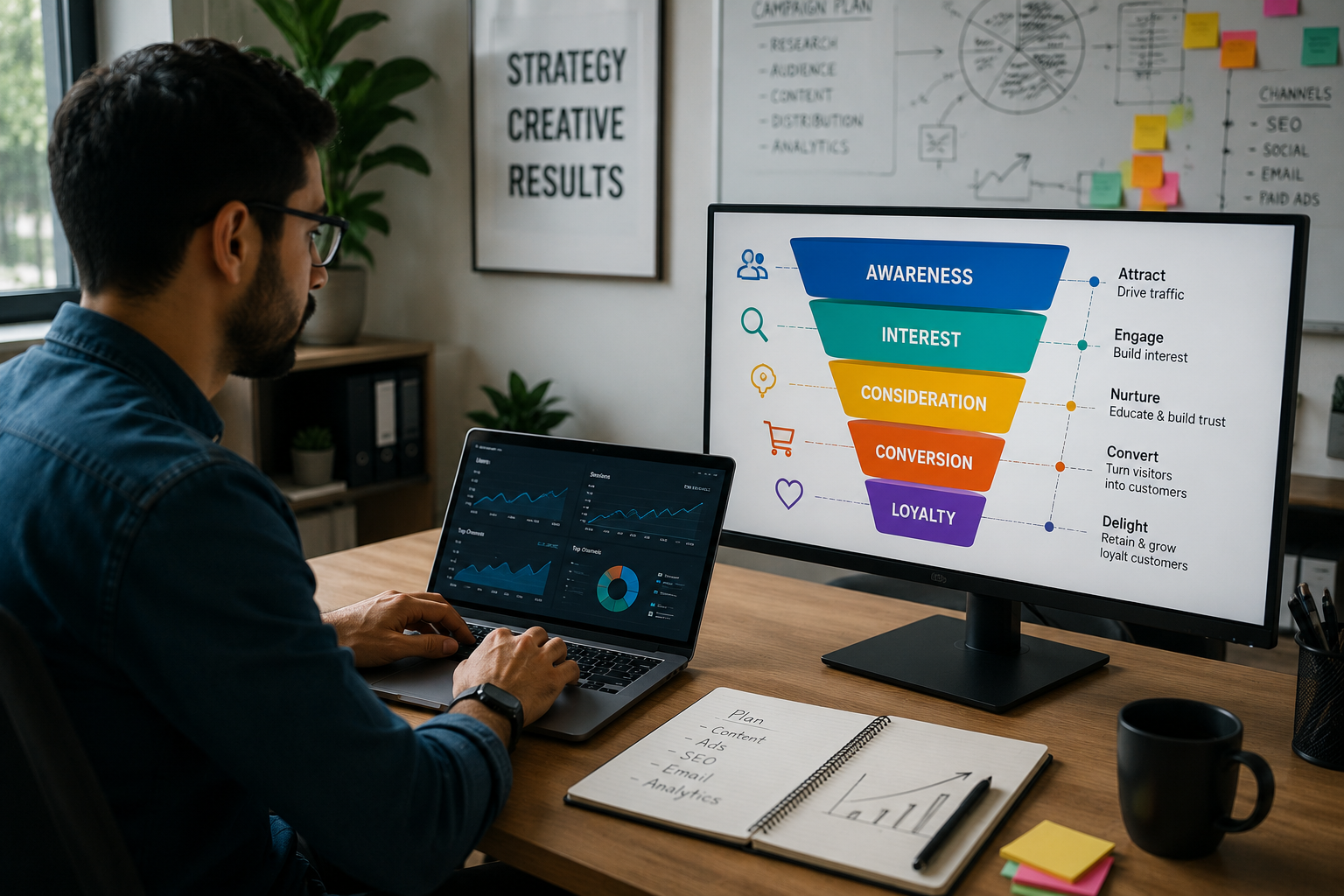
A digital marketing funnel is a practical way to organise how strangers discover a business, evaluate its offer, become customers and decide whether to return. The journey is rarely a straight line. A buyer may see a social post, search the brand several days later, read a comparison page, leave, return through an email and finally convert on a mobile device.
The funnel is still useful because it gives every channel a job. It prevents a common mistake: expecting every advert, blog or email to produce an immediate sale. Instead, marketers design the right message, experience and measurement for each stage of the decision.
Start with the business action, not the channel
Before choosing SEO, paid advertising or social media, define the action that matters. It might be a purchase, qualified enquiry, booked consultation, course application or repeat order. A campaign cannot be optimised properly when the team has not agreed what a valuable outcome looks like.
Separate macro conversions from micro conversions. A macro conversion creates direct business value. A micro conversion, such as viewing a pricing page, downloading a guide or watching most of a product demonstration, signals progress. Micro conversions help diagnose the journey, but they should not replace the final commercial goal.
Stage 1: Awareness
At the awareness stage, the customer recognises a problem, need or opportunity. The marketer’s task is not to explain every feature. It is to make the right audience notice a relevant idea and remember who introduced it.
Useful awareness channels include search-led articles, short-form video, social content, partnerships, podcasts, digital PR and carefully targeted paid reach. Strong creative connects a familiar problem with a clear point of view. Generic content may generate impressions, but it rarely creates memory.
Useful indicators include qualified reach, search impressions, new users, video completion, engaged visits and growth in branded search. Treat these as directional signals rather than proof of revenue.
Stage 2: Consideration
During consideration, buyers compare options and reduce uncertainty. They want to know whether the offer is relevant, credible and suitable for their circumstances. This is where detailed guides, demonstrations, case studies, FAQs, comparison pages, webinars and helpful email sequences become valuable.
The best consideration content answers the questions a salesperson hears repeatedly. It explains who the offer is for, what the process involves, what is included, what limitations apply and what the buyer should expect next. Clear information builds trust faster than exaggerated promises.
Track returning users, engaged sessions, downloads, webinar registrations, pricing-page visits and qualified enquiries. More importantly, examine which questions or objections repeatedly stop people from progressing.
Stage 3: Conversion
Conversion is the point where interest becomes action. The landing page, offer, form and follow-up process must work together. A strong advert cannot rescue a confusing page, and a polished page cannot rescue an offer that does not match the audience’s need.
Reduce unnecessary friction. Keep the message consistent from advert to landing page, show the essential evidence near the decision point, ask only for information the team will actually use and explain what happens after submission. On mobile, test every field, button and confirmation message.
Core conversion measures include conversion rate, cost per lead, customer acquisition cost, revenue, return on advertising spend and lead quality. A lower cost per lead is not an improvement if the sales team receives irrelevant enquiries.
Stage 4: Retention and advocacy
The funnel should not end at the first sale. Retention is often where marketing becomes more efficient because the business already has permission, behavioural data and an established relationship. Onboarding emails, useful product education, customer support, loyalty offers and relevant follow-up content can increase repeat value.
Advocacy grows when the customer has achieved a real result. Ask for a review or referral after a meaningful success point, not immediately after payment. Measure repeat purchase, renewal, churn, customer lifetime value, review quality and referral volume.
A practical funnel for a professional training provider
Consider a training provider promoting a practical digital marketing course. An awareness article explains how digital marketing roles are changing. A short video introduces a common campaign mistake. A visitor then reaches a detailed course page that shows learning outcomes, delivery format and practical work. A live question session reduces uncertainty, and a concise follow-up email directs the prospect back to the application page.
Each asset serves a different purpose. The article earns discovery, the video creates recognition, the course page supports evaluation, the question session handles objections and the application page converts. Judging every asset only by last-click applications would hide most of the journey.
How to build your funnel
- Define one primary commercial outcome and the audience most likely to value it.
- Map the questions, objections and evidence needed at each decision stage.
- Assign a clear role to every channel and content asset.
- Create a consistent path from message to landing page to follow-up.
- Set up conversion tracking before launching the campaign.
- Review lead quality and customer value, not only traffic and clicks.
- Improve the weakest stage before increasing the budget.
Common digital marketing funnel mistakes
- Sending every audience to the same generic homepage.
- Using one message for people with very different levels of awareness.
- Optimising for cheap clicks instead of qualified outcomes.
- Collecting leads without a fast and relevant follow-up process.
- Ignoring retention while continually paying to replace lost customers.
- Changing several variables at once and losing the ability to learn from tests.
Learn to build campaigns that work end to end
The London School of Business Digital Marketing in Practice programme develops practical skills across customer journeys, websites, SEO, social media, content, paid advertising, email, analytics and campaign planning. It is designed to help learners connect individual tactics to measurable business outcomes.
Frequently Asked Questions
Is the digital marketing funnel still relevant when customer journeys are non-linear?
Yes. The funnel is a planning and measurement model, not a claim that every buyer follows identical steps. Use it to match content and metrics to different levels of intent while allowing customers to move backwards, forwards and across channels.
Which funnel stage should a small business improve first?
Start with the clearest constraint. If traffic is relevant but nobody enquires, improve the offer, landing page and conversion process. If the page converts well but too few suitable people find it, strengthen awareness and acquisition.
How often should a funnel be reviewed?
Monitor campaign health regularly, but make strategic changes only after enough reliable data has accumulated. Review lead quality with sales or customer-service teams because analytics alone cannot show whether an enquiry is commercially useful.