
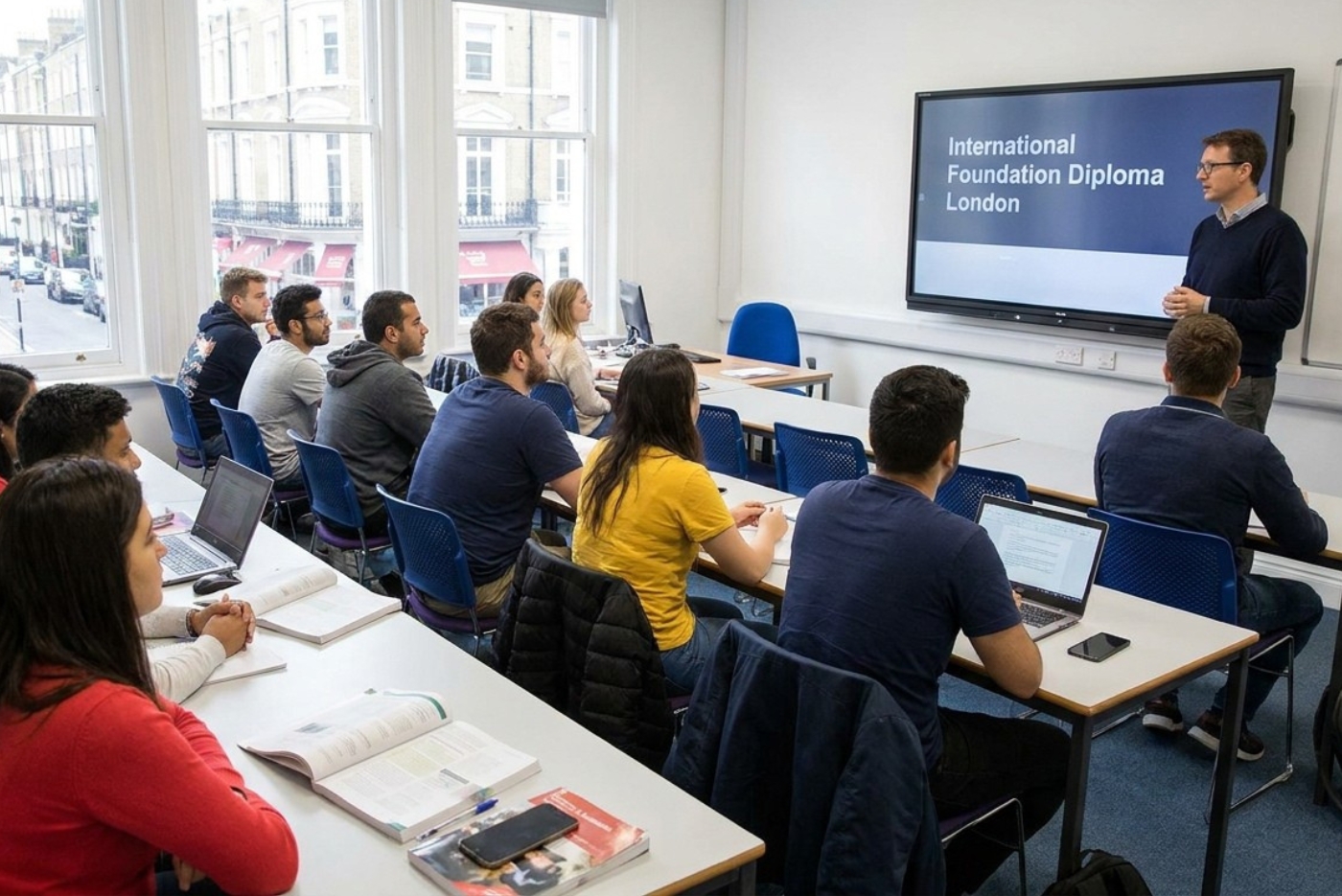
An international foundation diploma in London is the single most practical university entry route for international students whose home qualifications do not map directly onto UK undergraduate entry requirements. In 2026, with UK visa fees rising, the competitive UCAS cycle getting tighter, and more universities restructuring their entry pathways, understanding exactly what an international foundation diploma in London delivers and how it compares to other options is essential before you commit. This is the honest version.
What Is An International Foundation Diploma In London?
An international foundation diploma in London is a Level 3 qualification specifically designed for students coming from outside the UK who need to bridge the gap between their home country education and the academic standard required by UK universities. It typically covers three core areas:
Subject-specific content aligned with your intended degree, such as business, economics, law or technology.
Academic English, including essay writing, research methods, reading academic texts and presenting arguments in English at the level expected by UK universities.
Study skills, including time management, critical thinking, referencing conventions and independent research.
The international foundation diploma in London is distinct from a standard A Level or BTEC in one important way: it is built for students navigating a system that is not their own. The curriculum assumes you are academically capable but unfamiliar with UK conventions. That is not a deficit. It is a starting point.
A completed international foundation diploma in London grants direct entry to Year 1 of an undergraduate degree without requiring the student to reapply through UCAS, provided the agreed progression grades are met. This guaranteed progression route is what makes the international foundation diploma format significantly more reliable than attempting direct university entry with unevaluated overseas qualifications.
Why London Specifically For An International Foundation Diploma?
London is the most internationally diverse city in the UK, which means an international foundation diploma studied here offers immersive English practice that cannot be replicated elsewhere. Students on an international foundation diploma in London are living and studying in an environment where English is used authentically every single day, not just inside a classroom.
The practical differences compound quickly. A student completing an international foundation diploma in a smaller UK city is surrounded by a more homogenous environment. A student completing their international foundation diploma in London is negotiating a commute, shopping in a multilingual market, working alongside classmates from twenty countries, and building the cultural literacy that UK employers value alongside the qualification itself.
London also gives international foundation diploma students access to the UK’s largest concentration of business, finance, legal, creative and technology sector employers, which is directly relevant to anyone completing a business-focused foundation pathway.
International Foundation Diploma London: Who Is It For In 2026?
The international foundation diploma in London is suited to students in the following situations:
Students whose home country qualification, such as a high school diploma, national secondary certificate or equivalent, does not meet direct entry requirements for their target UK degree programme. UK ENIC, the national information centre, can assess whether your existing qualifications qualify as equivalent to A Levels. If they do not, the international foundation diploma is your direct next step.
Students who completed their home country qualification more than three years ago. Several UK universities require qualifications to have been awarded within the last three years for direct entry. An international foundation diploma studied in London resets this clock.
Students whose English proficiency sits between IELTS 4.5 and 5.5. Most direct degree entry requires IELTS 6.0 to 6.5. The international foundation diploma in London is designed for students starting at the lower threshold, with Academic English built into the programme so you exit at the required level.
UKCISA confirms that international students enrolled on an international foundation diploma in London are eligible for a Student visa, with full protections and rights during their study period.
How The International Foundation Diploma In London Fits LSB
At the London School of Business, our programmes in Luxury Brand Management, AI for Leaders and Executives, and Business Management attract students from over 50 countries. A significant number of those students arrive via foundation pathways, and the international foundation diploma in London is the most common of those routes.
The transition from an International foundation diploma to an LSB programme is direct and well-supported. Students who have completed foundation-level study in business, economics or management already understand how to structure an academic argument, manage their own reading schedule, and engage with case-based learning, which is exactly the environment our programmes operate in.
View current LSB entry routes and programme details at lsbuk.com. If you are currently completing or considering an international foundation diploma in London and want to understand how it aligns with LSBUK’s specific programmes, contact our admissions team directly at lsbuk.com/contact.
Frequently Asked Questions
Q: How long does an international foundation diploma in London take?
A: Most international foundation diploma programmes are one academic year, running from September to June. Some institutions offer accelerated six-month versions for students who already have stronger English and just need the subject-specific academic preparation. Always confirm the duration and scheduled intake dates before applying.
Q: Does an international foundation diploma in London guarantee university entry?
A: It guarantees progression to the partnered degree programme provided you meet the exit grade requirements agreed at the start of the programme. It does not guarantee entry to any UK university you choose independently. If you want flexibility to choose your destination university after completing the diploma, apply through UCAS using your diploma results as your qualification evidence.
Q: Can I work part-time while completing an international foundation diploma in London?
A: Yes. Students on a UK Student visa can work up to 20 hours per week during term time and full-time during official vacation periods. Your specific rights depend on the visa conditions stated on your Biometric Residence Permit. Check the latest conditions at gov.uk/student-visa before making assumptions about working hours.