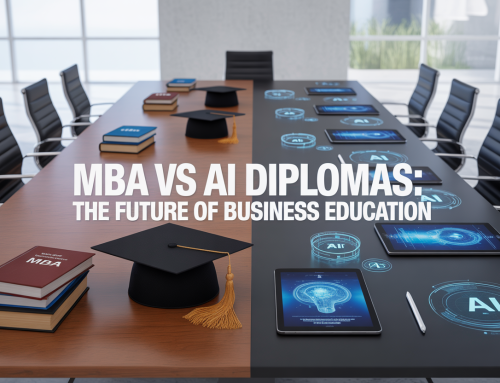
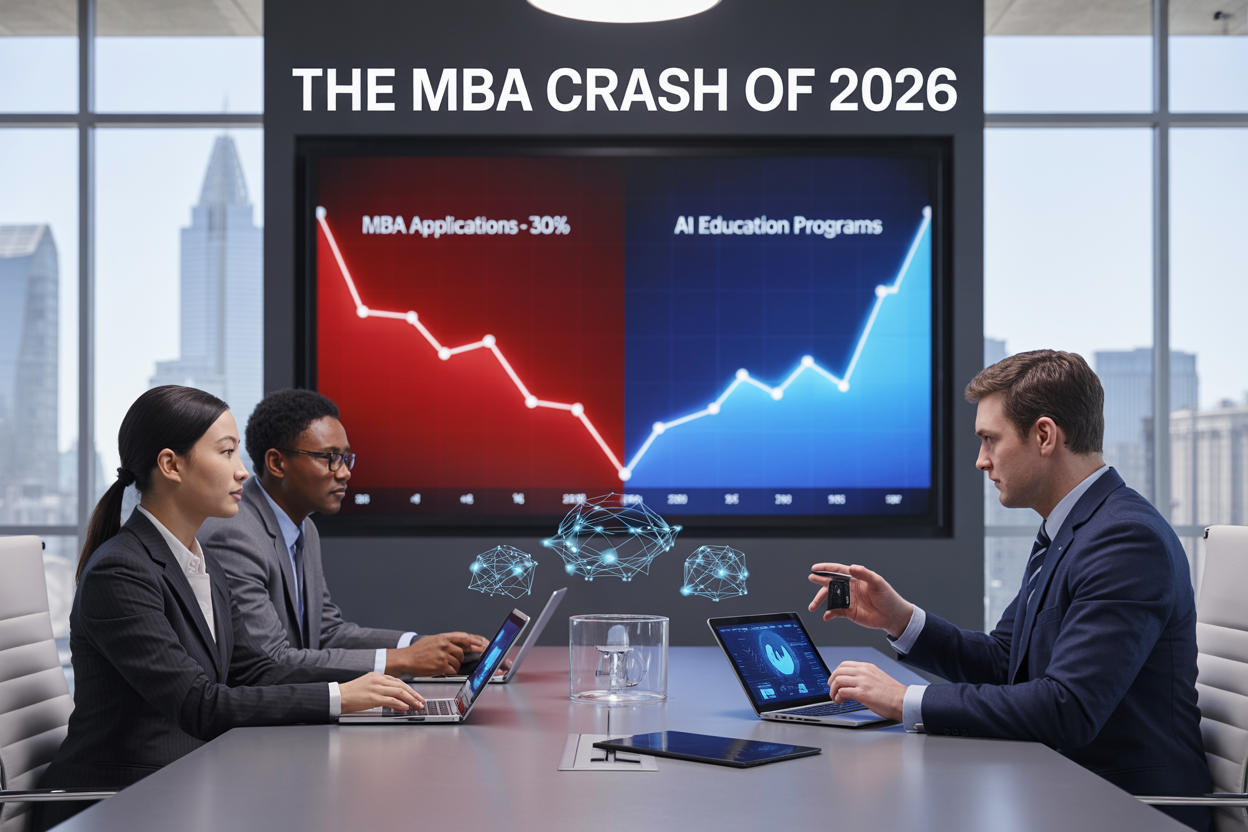
The MBA is experiencing its worst admissions crisis in 30 years and it’s not a blip, it’s a collapse.
Data released this week confirms what admissions consultants have been whispering since January: Top-tier US business schools are facing application declines of 20% to 30% in the 2026 cycle. One top-ten program reported a 30% plunge in rounds one and two. Another top-20 school saw international applications crater by 43%.
The cause isn’t economic recession (which historically boosts MBA applications). It’s political arithmetic and ROI reality. And it’s creating a once-in-a-generation shift in how business leaders get educated.
The Perfect Storm Hitting Business Schools
Three seismic changes converged in February 2026 to break the traditional MBA model:
1. The $100,000 Visa Wall
On January 8, 2026, the H-1B visa fee for employers jumped to $100,000 a staggering increase designed to price out international talent. For international students who viewed the US MBA as a pathway to Silicon Valley or Wall Street, the math no longer works. The traditional bargain $150,000 tuition for access to the US job market collapsed overnight when the visa bridge burned.
2. The OPT Death Watch
The Optional Practical Training program that allowed international graduates to work for three years post-MBA is now under “regulatory threat” according to federal officials. With work authorization no longer guaranteed, applications from China, India, and Latin America have evaporated.
3. The “Smarter Generation” Effect
As admissions expert John Byrne noted this week: “The 2026 MBA application slump is not a crisis it is a course correction reflecting a smarter generation reframing the value of education”. Prospective leaders are choosing “skill velocity over credential velocity”.
The Rise of the Specialist: Why AI Diplomas Are Winning
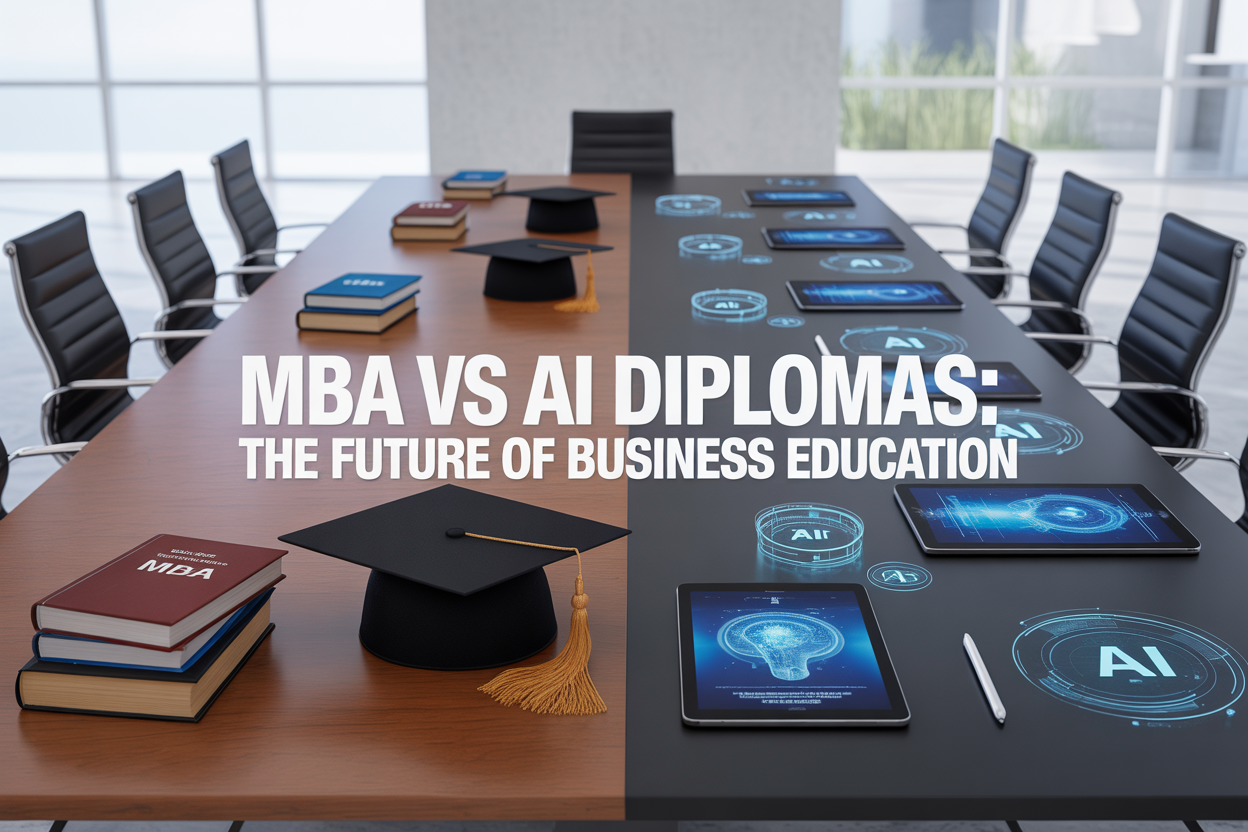
While MBA applications plummet, the B2B continuing education market is surging to $10.08 billion by 2030. The difference? Specialization.
Modern executives don’t need two years of general management theory. They need AI fluency, business agility, and real-world impact metrics delivered in months, not years.
The Diploma in AI for Leaders and Executives at LSBUK represents the alternative:
- Duration: 4–6 months (vs. 24 months)
- Cost: £4,750–£8,500 (vs. £100,000+)
- Focus: Agentic AI governance, hybrid leadership, and “change fitness” the exact skills Harvard Business School faculty identified as the “AI differentiator” for 2026
- Outcome: Strategic AI implementation without coding, not theoretical case studies
Why Generalist Degrees Are Failing
MBA programs teach “well-rounded leadership.” But 2026 demands T-shaped professionals: deep expertise in AI strategy, broad business context.
While MBA students memorize frameworks from companies that no longer exist, AI diploma students learn:
- AI Discernment: Knowing when not to use AI (a critical leadership skill identified by USAII this month)
- Agentic AI Governance: Managing autonomous systems that plan and execute without human supervision
- Organizational Change Fitness: The “capacity to metabolize significant and ongoing change” that Harvard’s Tsedal Neeley calls the defining trait of 2026 leadership
The New ROI Calculation
The MBA equation used to be simple: Debt now, salary premium later. But with US MBA graduates facing “choppy hiring cycles” and AI-driven restructuring eliminating entry-level management roles, the premium has vanished.
Meanwhile, B2B continuing education focused on AI and reskilling is growing at 9.8% annually because it delivers immediate, measurable ROI. As one recent graduate of LSBUK’s AI program noted: “I implemented an AI workflow automation in week three that saved my department £50,000. Try doing that with a case study about Southwest Airlines from 1998.”
The Future Is Modular, Not Monolithic
The MBA’s two-year, full-time model was designed for an industrial economy where executives had time to “find themselves.” In 2026, with AI disrupting business models quarterly, leaders need continuous, modular upskilling not sabbaticals.
The AI for Leaders Diploma offers exactly this: modular content covering “AI and Business Strategy” through to “Measuring AI Value and ROI,” culminating in a bespoke AI strategy roadmap for your organization.
Conclusion: Don’t Buy the Falling Knife
Application slumps create opportunity for applicants to get into schools that previously rejected them, yes, but more importantly, for professionals to question whether the degree itself still holds value.
The MBA isn’t just declining. It’s being actively disrupted by the same forces it failed to teach students to manage: AI automation, geopolitical visa chaos, and the shift from credentialism to demonstrated competence.
Smart leaders aren’t applying to business school in 2026. They’re getting AI-qualified in months.
Secure your competitive advantage with the February 2026 AI for Leaders intake before your competitors finish their MBA applications.
FAQs:
Q: If I already have an MBA, is it worthless now?
A: Not worthless, but incomplete. Many of our AI Diploma students are MBA holders updating their skillsets. The MBA provides general business context; the AI Diploma provides the technical strategy and governance skills needed for 2026 leadership. Think of it as a booster shot, not a replacement.
Q: Will employers respect a diploma instead of an MBA?
A: Google, Meta, and IBM no longer require degrees at all. What they require is demonstrated AI literacy and strategic implementation ability. Our diploma is British Council accredited and focuses on portfolio-ready projects, not theoretical exams. In 2026, skills > credentials.
Q: How quickly can I complete the AI Diploma if I need to upskill urgently?
A: The intensive London format takes 4 weeks full-time; the online option takes 6 months part-time. Compare that to 24 months for an MBA. If your industry is being disrupted by AI now (and it is), you don’t have two years to wait.